
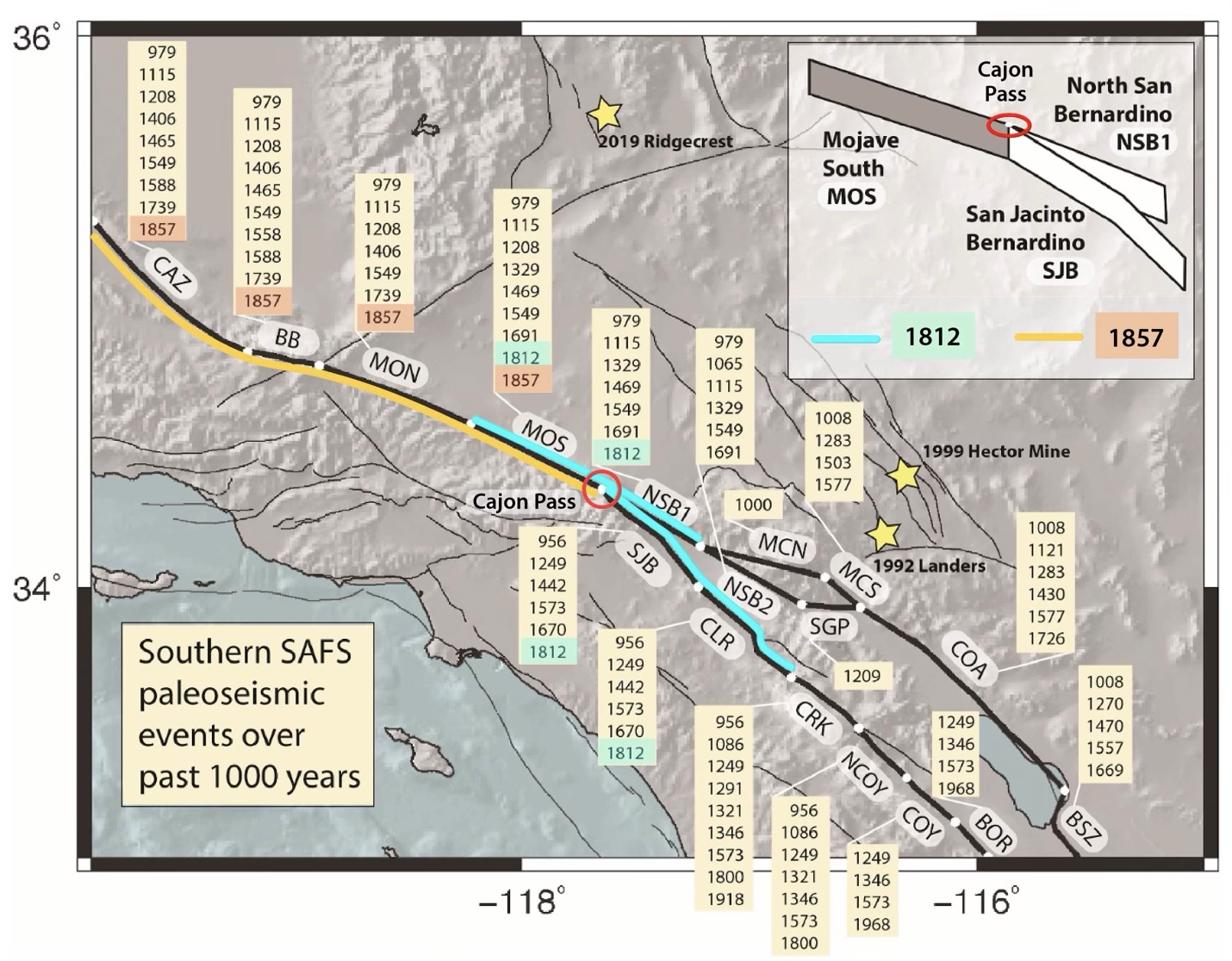
Figure 3. This version of past ruptures is used by Burkhard et al. (2026), adopting a modified version of the Maximum Rupture Model of Scharer and Yule (2020) and the simplified fault geometry shown here. I’ve annotated this figure to highlight the 1812 (open gate) and 1857 (closed gate) earthquakes. The extent of the 1857 rupture is well known, but it is uncertain for 1812. The authors assume a model based on Yule et al. (2007) and Rodríguez Padilla et al. (2021), rather than that of Lozos (2016). Credit: Modified from Figure 2 of Burkhard et al. (2026)

Alka Tripathy-Lang is a freelance science writer based in Chandler, Arizona, and holds a Ph.D. in geoscience.
Latest posts by Alka Tripathy-Lang, Ph.D. (see all)
- Living through the Loma Prieta earthquake - October 21, 2021
- The Great Quake Debate: an interview with seismologist and author Susan Hough - August 27, 2020
- Salton Sea Swarm quiets down - August 12, 2020