
A tribute to an earthquake scientist of uncommon insight, lucidity, and independence
By Ross S. Stein, Temblor, Inc.
Between 1984 and 1996, British geophysicist Geoff King and I wrote eight papers together. We worked in the field in California, Nevada and Greece, and we worked in each other’s offices and homes in Menlo Park, Cambridge, Boulder and Strasbourg.
In 1993, while Geoff was at the Institut de Physique du Globe de Strasbourg, I visited and we hit on a plan to write a paper in August because everybody would have vacated (for vacation, of course). There would be no distractions. But we discovered August in France meant that even the simplest services — like getting printer or toilet paper — broke down. We persisted, having to write in the hallway because his office was being painted. The result: King et al. (1994), which contains iconic figures of aftershocks preferentially occurring where Coulomb stress had increased following the 1992 Landers earthquake.
The remainder of this essay covers the brief period in Geoff’s multifaceted and multinational career during which I was fortunate enough to have him as a mentor, collaborator and friend.
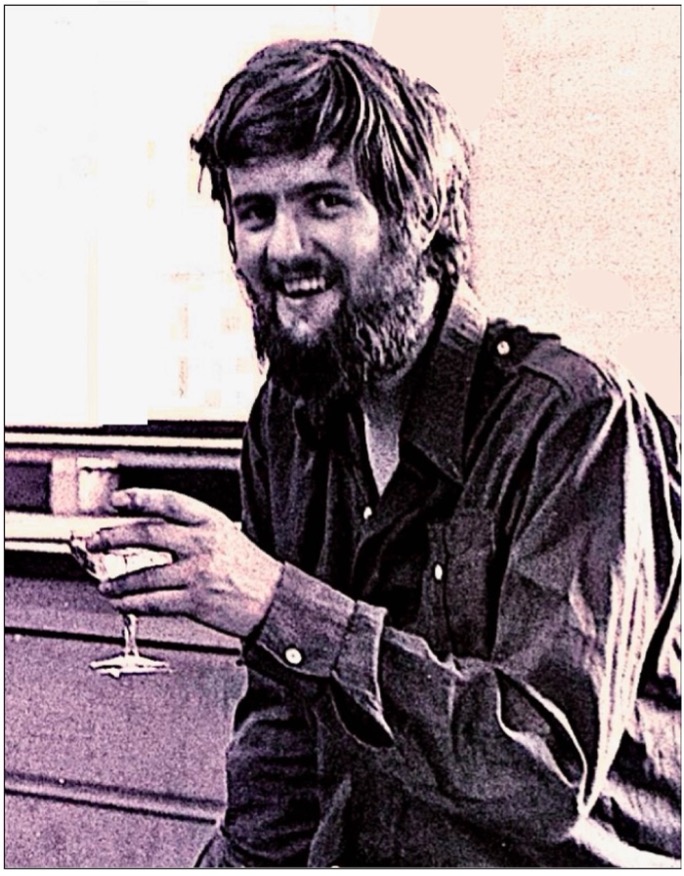
Geoff’s gift
Although Geoff was ten years older than me and had vastly more research experience, he never treated me as his junior; his gift was that we worked as equals. We solved the authorship problem by rotating first author in each of our eight papers, and by putting “order of authorship chosen by lot” in each acknowledgement. There was one exception: We presented the concept as Part 1 with Geoff as first author, and the data as Part 2 with myself first; John Rundle was third author on both. This pair, Repeating Earthquakes and the Growth of Geological Structures, became known to us as Repeated Papers and the Growth of the Geological Literature. You have my apology.
Geoff took a liberal attitude about journal reviews. He inserted all the qualifiers and counter-arguments demanded by the reviewers. Then, after the paper was accepted, he would take them all out! I was shocked, but he said it was his paper and he would be damned before others could harness him. I hope they never found out.
Geoff taught me how to present and defend our work, both in print and at the lectern. In the 1980s, there was much more open combat at conferences and seminars. Scientific public speaking was not quite a blood sport, but at some venues it came close. Today such crossfire would be considered harassment. The dialogue is thankfully more civil, but it is also less revealing.
In 1988, Geoff and I gave a series of university talks in which he presented the first half and I the second. He spoke in a resonant, authoritative baritone that held an audience in its grip. I will never forget Gerald Wasserburg — a founder of the field of geochemistry — coming in late to our Caltech talk and then immediately trying to shred Geoff. Had I been on the stage, I would have died. But Geoff kept his cool, finally saying, “Jerry, you are going to have to listen to the rest of my talk before firing another question.” It was an instant education.
A year later, in 1989, when I was giving a talk at Cambridge, Dan Mackenzie — a founder of the field of plate tectonics — went for the jugular (because the 1983 magnitude 6.9 Borah Peak, Idaho, quake struck on a high-angle normal fault and not on his preferred low-angle décollement). I knew just what to do. But I also knew that no matter what I did, I would not carry the day. When you are pushing back against a founder of a sub-field of your science, you will not prevail — at least not in the moment. These people are signaling to the audience that they are not buying the case you are making. But you can still hold your head high.
Geoff’s Paris
Geoff was equally at home whether in the field, in coding, or in instrumentation, where he had cut his teeth at Cambridge. He spent so much time in the field that I wondered when he did his laundry. But when one looked at his clothes, you realized he didn’t.
He was an unstintingly independent — as opposed to an institutional — scientist; not until he joined the Institut de Physique du Globe de Paris in 1995 did he truly come home. He then became fiercely loyal to his Parisian colleagues, and fell in love with French culture and cuisine.
The transition for a Brit is not easy: He told me he worked hard to be late for every social engagement, because in France, “dinner at 8” means 9. He said that the key to fitness was not to eat any animal that lived a more sedentary life than you do, but he didn’t seem to follow his own advice. He would hold dinner parties where the menu was cheese and wine — and nothing else! So, his waistline grew with his scientific stature.
Hidden earthquakes
I first met Geoff in 1983 when he gave a talk at the USGS about the history of strain measurements, which for every advance or discovery by one person, someone else got the credit. It was so funny and audacious that I asked if I could make a copy of his overhead projector slides. He agreed.
At the time, I had been working on the 1983 magnitude 6.7 Coalinga earthquake, which struck on a buried thrust fault. Geoff had just returned from Algeria where he studied the much larger buried fault that hosted the 1980 magnitude 7.3 El Asnam quake. We decided to work together to probe the commonalities about these ‘hidden earthquakes.’
Fault bends
During the rest of the 1980s, Geoff focused his attention on fault bends, fault networks, fault evolution and ultimately, fault interaction. This work was inspired by what he saw in the field, as well as in the constantly improving seismicity and deformation data.
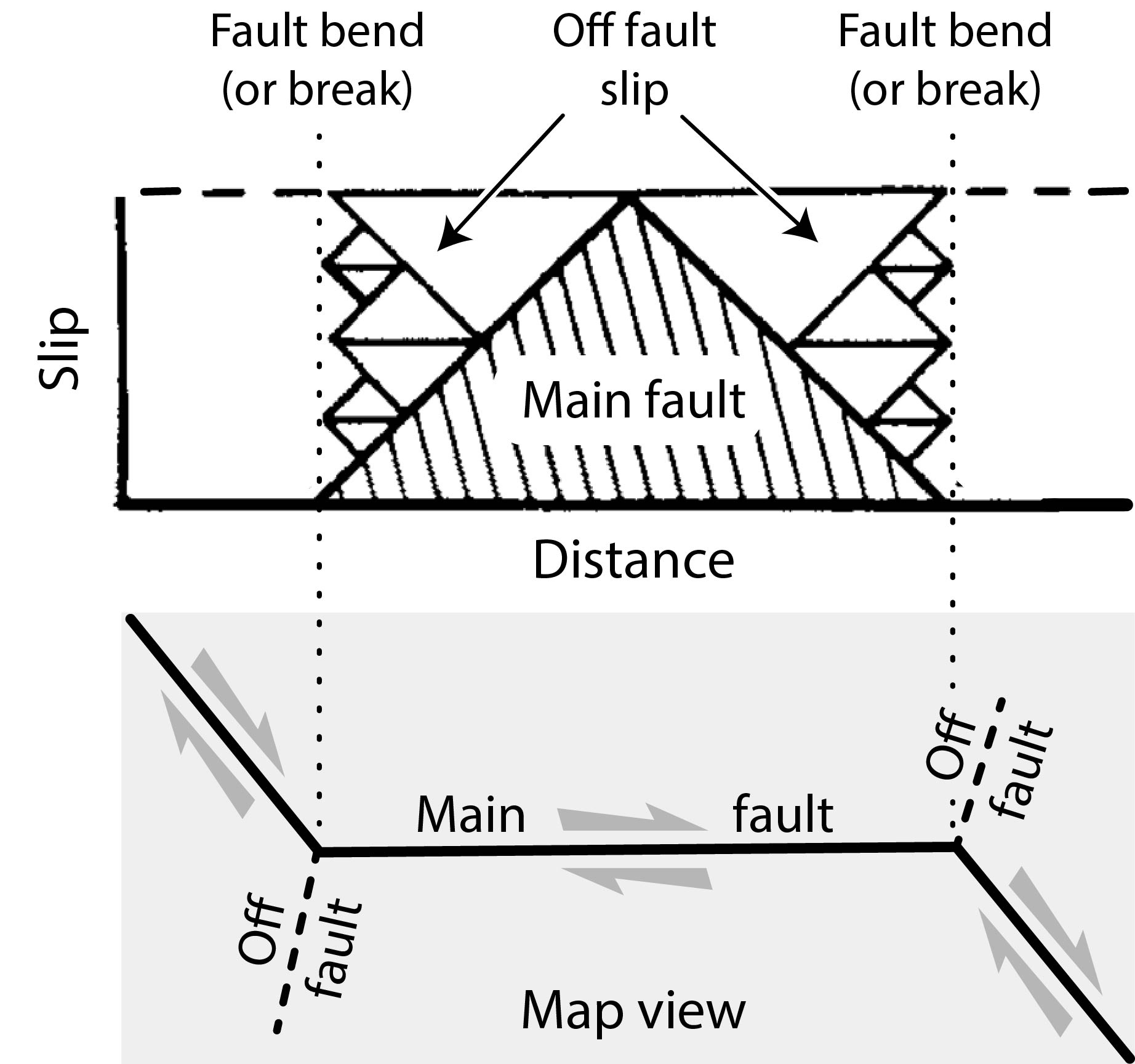
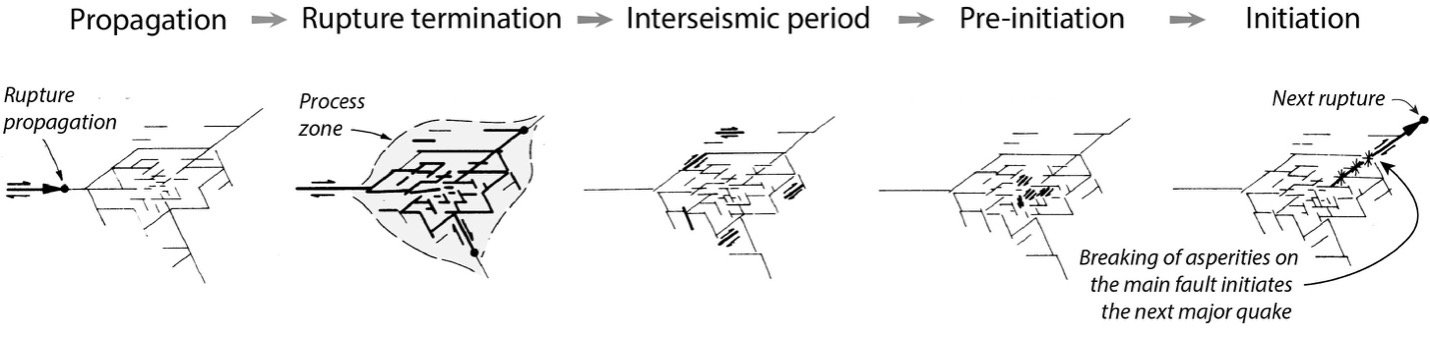
In a seminal paper on the importance of off-fault deformation and secondary faulting (King, 1983), Geoff wrote, “The b-value [the ratio of the frequency of large to small shocks] of unity found empirically can be regarded as a consequence of three-dimensional self-similar fault geometry, which requires that a substantial proportion of the deformation in a fault system occur on minor faults and not on the main faults.” This is elegantly illustrated in Figure 2.
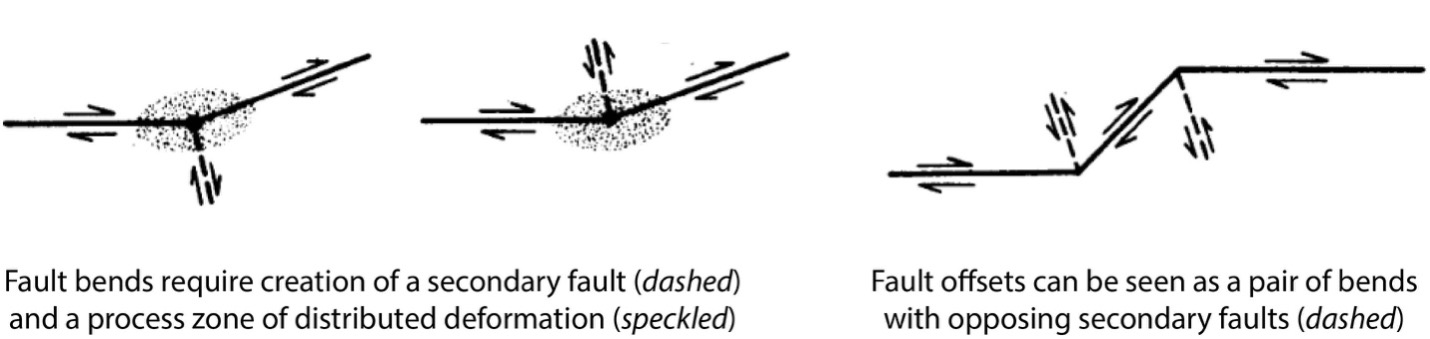
In another paper Geoff wrote with John Nabelek (King and Nabelek, 1985), they focused on the bends in faults (Figure 3 and 4). “Because of their importance in the rupture process, bend zones should be monitored for precursory effects,” they wrote.
Today, 40 years later, we can map fault bends with great fidelity through relocated seismicity, moment tensors and crustal deformation imaged via satellites. These observations reveal that fault bends and secondary faults are indeed abundant, if not ubiquitous.
Geological structures
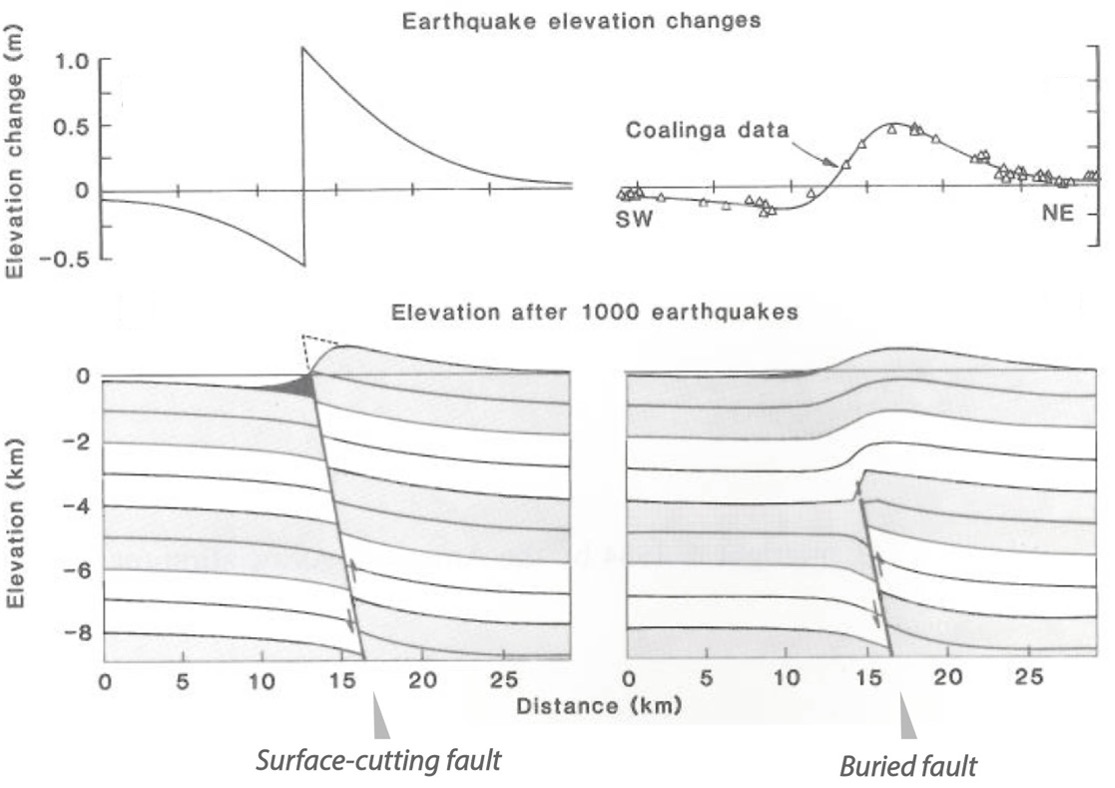
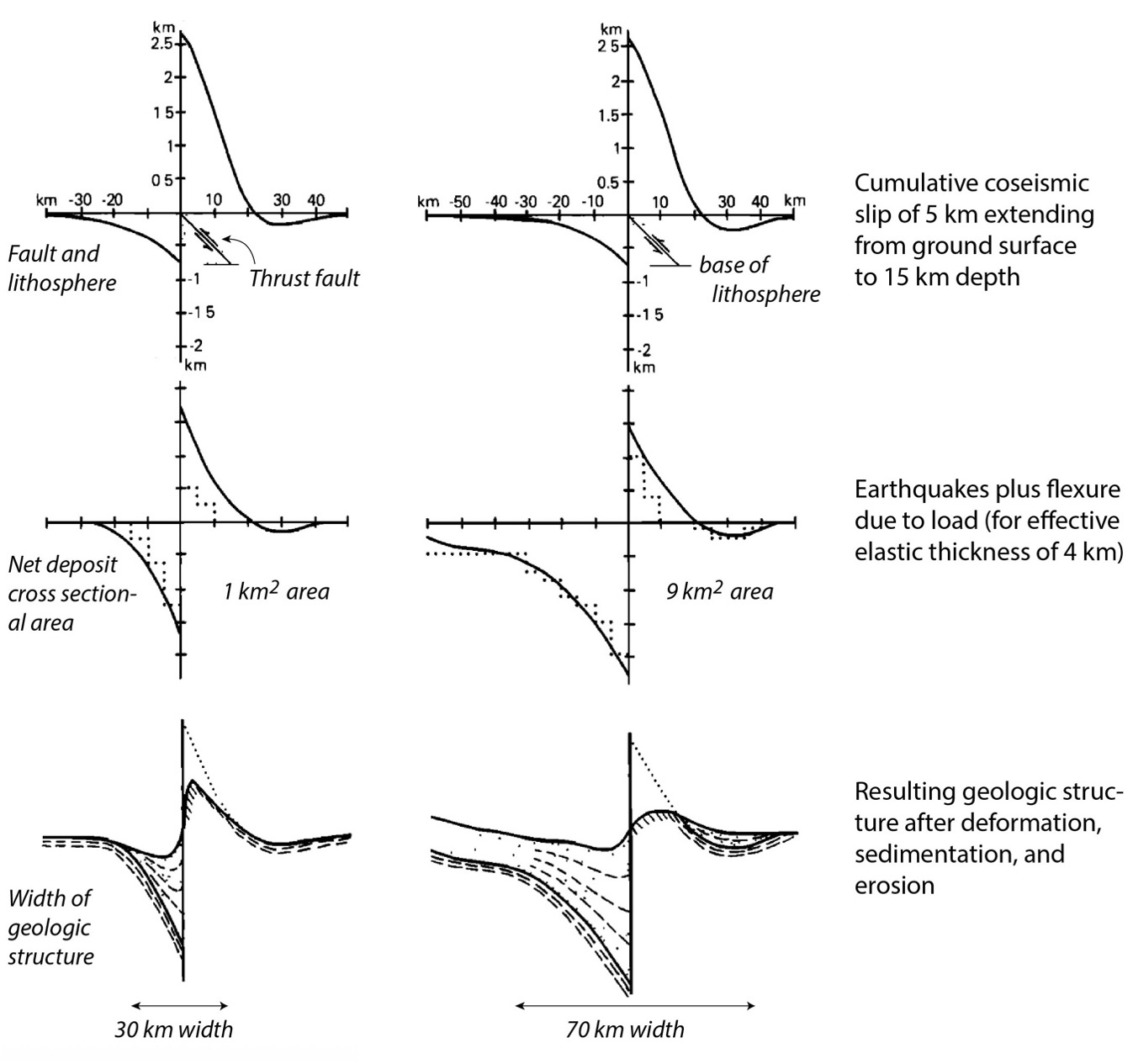
In King et al. (1988), Geoff began with the idea that relatively small deformations associated with individual earthquakes accumulate over eons. One earthquake won’t make a mountain, but every rumble and jolt, cumulatively, will. Deformation is also caused by the deposition or erosion of sediment, which either loads or unloads the crust, flexing it. Together, these two sources of deformation shape what we see in the field. The case for surface-cutting thrust faults is shown in Figure 5, but the paper also explored normal fault structures.
Fault gouge
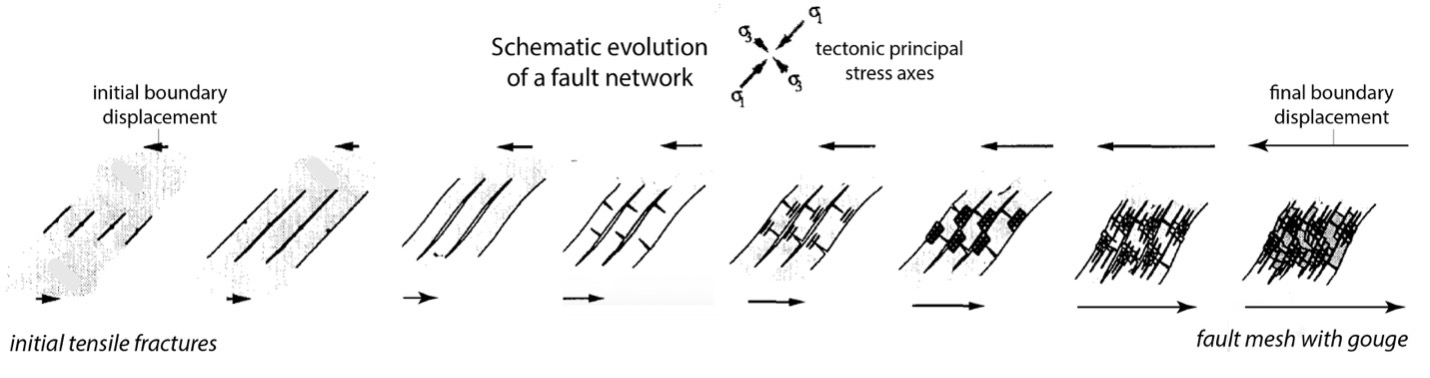
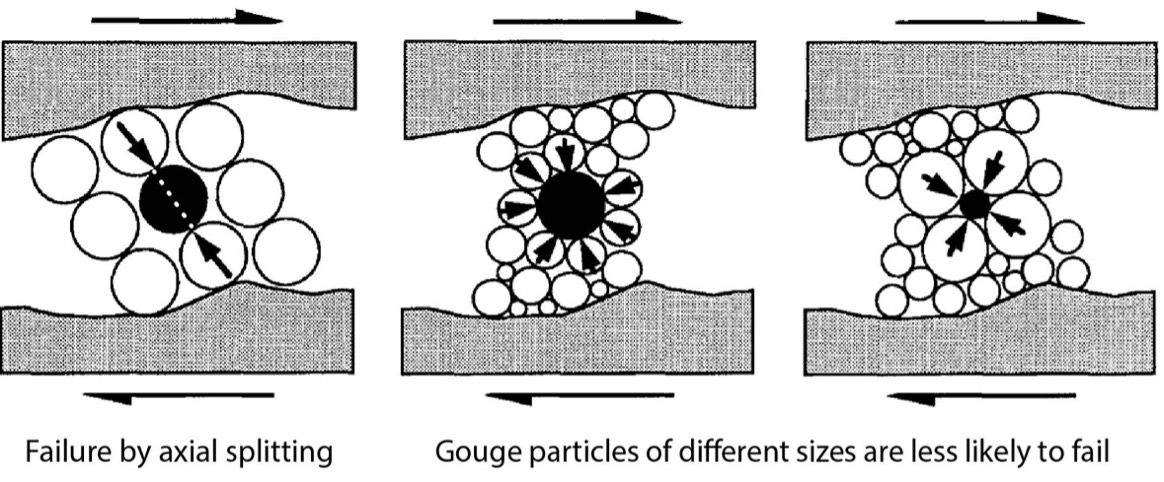
Working with Charlie Sammis, Geoff explored fault networks and the formation of fault gouge, the powder found in fault zones whose properties exert a major influence on earthquake nucleation and fault friction. King and Sammis (1992) proposed how isolated tensile fractures could evolve into a fault mesh suffused with gouge (Figure 6) and how gouge particles can reach a steady state when there is a diverse population of grain sizes (Figure 7).
Fault interactions
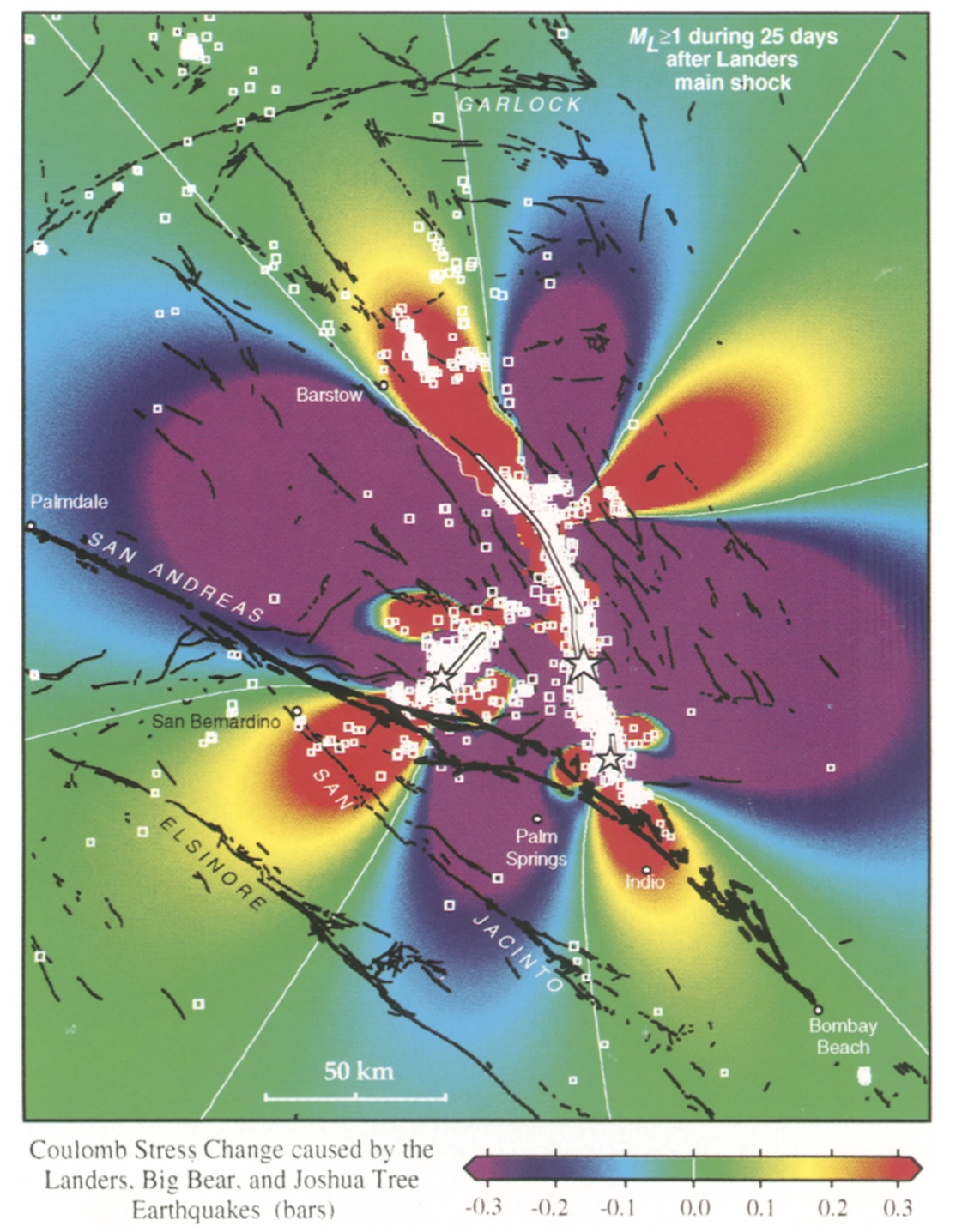
The 1992 magnitude 7.3 Landers earthquake was the best recorded and most exotic event most of us had ever seen. Several faults ruptured together, propagating through bends, breaks and process zones like those shown in Figures 3 and 4. Aftershocks lit up the rupture zone, but there were clusters of off-fault aftershocks up to 40 kilometers away. The off fault seismicity and highly bent and en echelon rupture embodied everything that Geoff had worked on during the preceding decade. And so, Geoff, Jian Lin and I immediately started trying to understand and model the distribution of aftershocks (Figure 8). Working independently, Ruth Harris and Bob Simpson at the USGS, and Steve Jaumé and Lynn Sykes at Lamont Doherty Earth Observatory did the same. All three groups operated in the intertidal zone between collaboration and competition, and we all published during the same week in Science and Nature, five months after the quake struck.
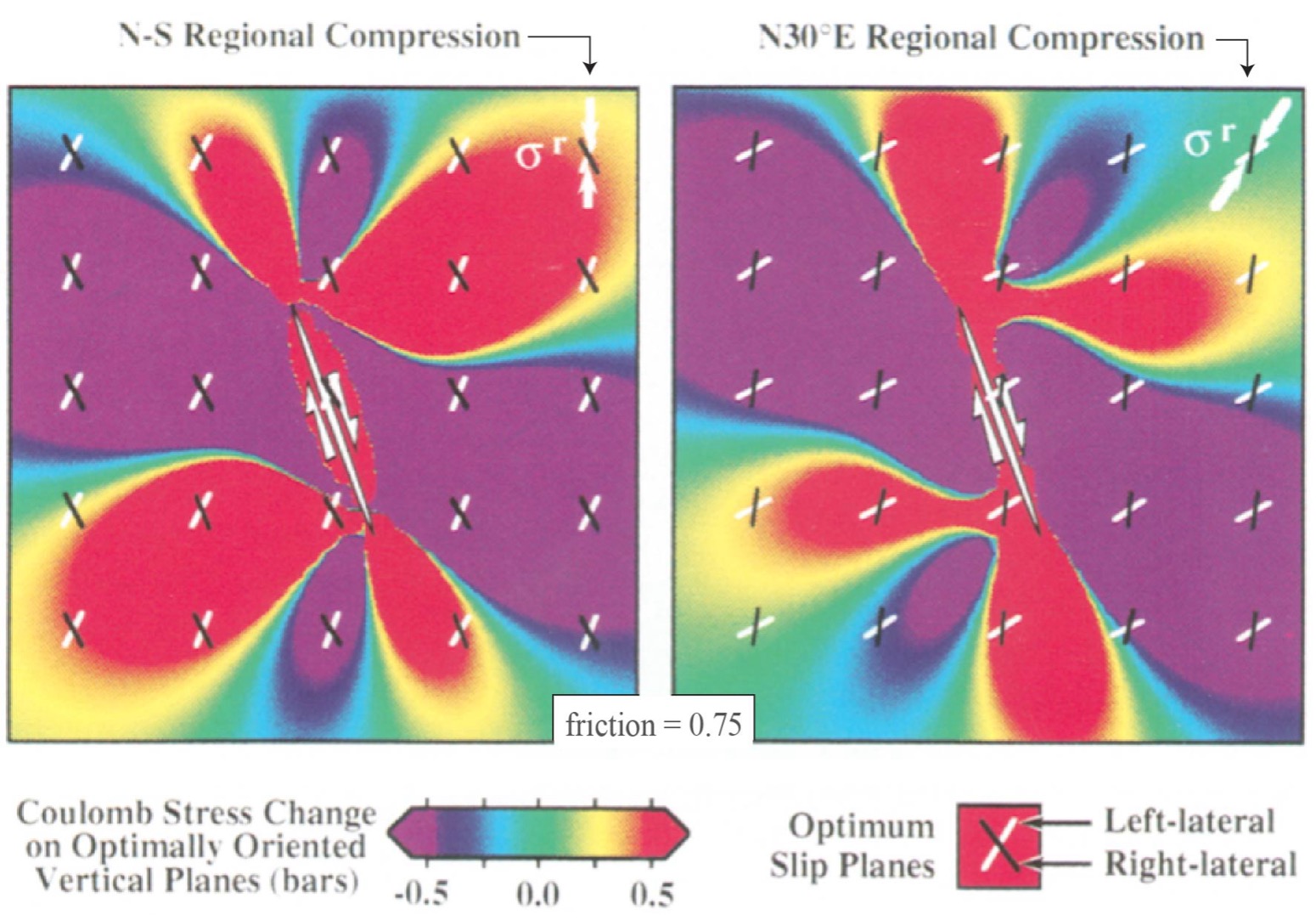
Geoff’s unique contribution was producing maps of the Coulomb stress change on ‘optimally oriented’ faults (Figure 9), whereas the other papers calculated the stress change resolved on the major mapped faults. Strongly influenced by his observations of fault networks in field exposures, Geoff’s insight was that the crust contains a myriad of faults with diverse orientations nearly everywhere, and so aftershocks at any point would be most likely to strike on faults that had the highest Coulomb stress — the ones brought closer to failure. These were the optimal planes.
To calculate the optimal planes, one added the stress imparted by the earthquake to the regional stress. Given an assumed fault friction coefficient, one could calculate the optimal planes for failure. In the 1990s, focal mechanisms were available only for large shocks, so we could not confirm that the aftershocks actually occurred on the optimal planes. Nevertheless, the agreement between the modeled and observed spatial distribution of aftershocks in Figure 8 suggested that the concept was sound.
Before this work, aftershocks were thought to occur along the fault rupture; afterward, aftershocks were understood to strike where the stress change brought faults closer to failure. Although this typically included the fault rupture, it was not restricted to the rupture. Geoff’s insight led to a better understanding of progressive (or ‘falling-domino’) earthquake sequences, aftershocks and doublets. The widely used open source code we produce today for earthquake interaction calculations, Coulomb 4.0 (Yoshizawa et al., 2026), is simply an evolution of Geoff’s 1992 VARC code, and so his insights and solutions live on not only in his papers, but also in the tools he brought to life.
Believability and Correctness, Data and Models
In 2003, Geoff wrote, “To be a major contribution, scientific papers must score well in both ‘believability’ and ‘correctness.’ The history of science is littered with papers that were correct, and not believed at the time, and the reverse.” One might argue that believability has nothing to do with science, and that only correctness counts. Although believability opens the door to bias and even prejudice, I think Geoff meant that a paper must not just reveal but also persuade. Scientific audiences are highly skeptical, and their reaction to new work generally flits from “it’s wrong” to “it’s obvious” in the blink of an eye. The goal is to land in the middle.
About his own work, Geoff wrote in the same interview, “Most of my effort is actually expended in data collection… computer models of earthquake processes are only as good as the data available to justify them. In response to a paper describing years of careful fault mapping, a reviewer remarked that ‘…data rarely if ever distinguishes between models.’ A Ph.D. from a top university, he was unwilling to accept that our data rendered his models improbable. Data is in short supply and is badly needed.” Geoff’s career was marked not only by gathering that essential data, but also by intuiting, interpreting and modeling it.
Geoff published with nearly a hundred coauthors and graduate students throughout his career; I am but one of that fortunate cohort. Geoff will be missed for his insights, clarity, inventiveness, adaptability, appetite and humor.
Note: Except for Figure 8, the figures reproduced here have been edited and annotated for the Temblor Earth News audience.
Reviewed by: Charles G. Sammis, Professor Emeritus at USC, and Adjunct Professor at UBC.
References
Harris, R. A., & Simpson, R. W. (1992). Changes in static stress on southern California faults after the 1992 Landers earthquake. Nature, 360, 251–254. https://doi.org/10.1038/360251a0
Jaumé, S. C., & Sykes, L. R. (1992). Changes in state of stress on the southern San Andreas Fault resulting from the California earthquake sequence of April to June 1992. Science, 258(5086), 1325–1328.
https://doi.org/10.1126/science.258.5086.1325
King, G. (1983). The accommodation of large strains in the upper lithosphere of the earth and other solids by self-similar fault systems: the geometrical origin of b-Value. PAGEOPH 121, 761–815, https://doi.org/10.1007/BF02590182
King, G. C. P. (2003). Interview, Essential Science Indicators, Special Topic of “Earthquakes,” Published September 2003, http://www.esi-topics.com/earthquakes/interviews/GeoffreyKing.html
King, G. C. P., & Nábělek, J. (1985). Role of fault bends in the initiation and termination of earthquake rupture. Science, 228(4702), 984–987. https://doi.org/10.1126/science.228.4702.984
King, G. C. P., & Sammis, C. G. (1992). The mechanisms of finite brittle strain. Pure and Applied Geophysics, 138(4), 611–640. https://doi.org/10.1007/BF00876341
King, G. C. P., Stein, R. S., & Rundle, J. B. (1988). The growth of geological structures by repeated earthquakes: 1. Conceptual framework. Journal of Geophysical Research: Solid Earth, 93(B11), 13307–13318.
https://doi.org/10.1029/JB093iB11p13307
King, G. C. P., Stein, R. S., & Lin, J. (1994). Static stress changes and the triggering of earthquakes. Bulletin of the Seismological Society of America, 84(3), 935–953. https://doi.org/10.1785/BSSA0840030935
Stein, R. S., & King, G. C. P. (1984). Seismic potential revealed by surface folding: 1983 Coalinga, California, earthquake. Science, 224(4651), 869–872. https://doi.org/10.1126/science.224.4651.869
Stein, R. S., King, G. C. P., & Lin, J. (1992). Change in failure stress on the southern San Andreas Fault system caused by the 1992 magnitude 7.4 Landers earthquake. Science, 258(5086), 1328–1332. https://doi.org/10.1126/science.258.5086.1328
Stein, R. S., King, G. C. P., & Rundle, J. B. (1988). The growth of geological structures by repeated earthquakes: 2. Field examples of continental dip-slip faults. Journal of Geophysical Research: Solid Earth, 93(B11), 13319–13331.
https://doi.org/10.1029/JB093iB11p13319
Yoshizawa, K., Toda, S., Stein, R. S., Sevilgen, V., & Lin, J. (2026). Introducing Coulomb 4.0: Enhanced stress interaction and deformation software for research and teaching. Temblor. https://doi.org/10.32858/temblor.372 (download site: https://temblor.net/coulomb/)
Copyright
Text © 2026 Temblor. CC BY-NC-ND 4.0
We publish our work — articles and maps made by Temblor — under a Creative Commons Attribution-NonCommercial-NoDerivatives 4.0 International (CC BY-NC-ND 4.0) license.
For more information, please see our Republishing Guidelines or reach out to news@temblor.net with any questions.

- Is a doublet signaling the formation of a new basin in Sındırgı, Western Türkiye? - August 11, 2026
- Venezuela’s doublet leaned toward Caracas - June 30, 2026
- Is Southern California’s Cajon Pass an ‘earthquake gate’ ready to open? - June 29, 2026