
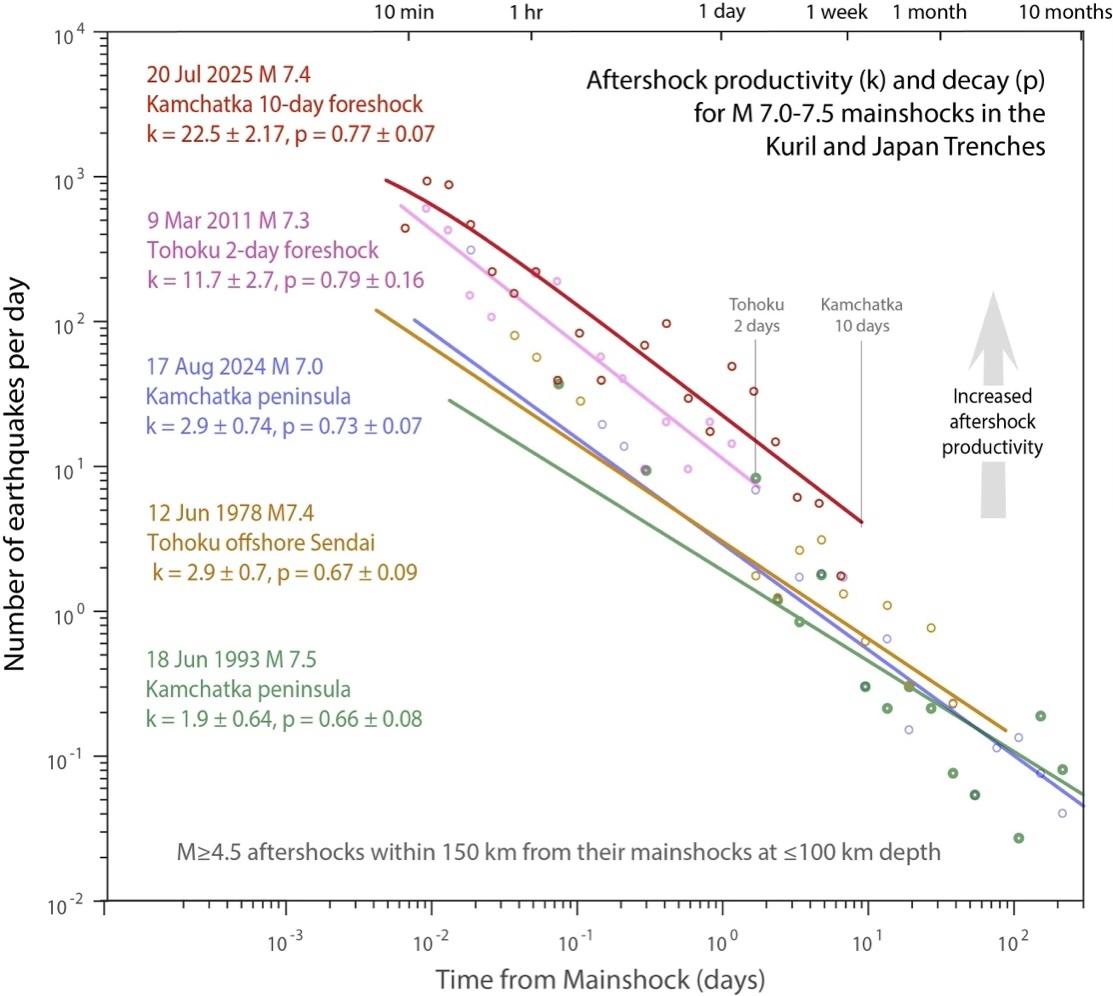
Figure 4. Aftershock decays calculated for five magnitude 7.0-7.5 shocks located in the Japan and Kuril trenches. All the mainshocks struck similarly active subduction zones at about the same depth and position in the trench. The data are noisy and the sample is small. Nevertheless, the magnitude 7.4 Kamchatka foreshock produced about ten times the number of quakes in 10 days than the others, and the 2-day Tohoku foreshock produced about five times the number in 2 days, suggesting that they are unique. Here, we use aftershocks of magnitude 4.5 and greater for up to one year. The 1978 and 1993 data are incomplete in the first 10-20 hours, and so those curves are drawn largely from day 1-100. Credit: Temblor, CC BY-NC-ND 4.0

Alka Tripathy-Lang is a freelance science writer based in Chandler, Arizona, and holds a Ph.D. in geoscience.
Latest posts by Alka Tripathy-Lang, Ph.D. (see all)
- Living through the Loma Prieta earthquake - October 21, 2021
- The Great Quake Debate: an interview with seismologist and author Susan Hough - August 27, 2020
- Salton Sea Swarm quiets down - August 12, 2020