
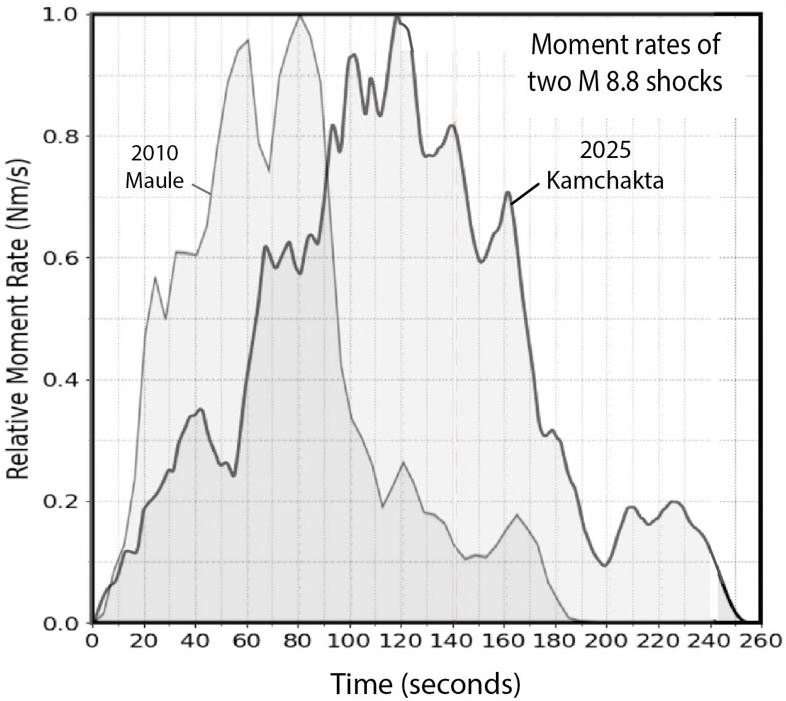
Figure 11. Although the Kamchatka earthquake took up to a minute longer to rupture than the Maule event, both were substantially complete by about 200 seconds after they nucleated, and so their rupture speeds are unlikely to explain their tsunami differences. Both source time functions were constructed by the USGS from similar data, using similar methods. Credit: USGS source time functions overlaid by Temblor, CC BY-NC-ND 4.0

Alka Tripathy-Lang is a freelance science writer based in Chandler, Arizona, and holds a Ph.D. in geoscience.
Latest posts by Alka Tripathy-Lang, Ph.D. (see all)
- Living through the Loma Prieta earthquake - October 21, 2021
- The Great Quake Debate: an interview with seismologist and author Susan Hough - August 27, 2020
- Salton Sea Swarm quiets down - August 12, 2020