
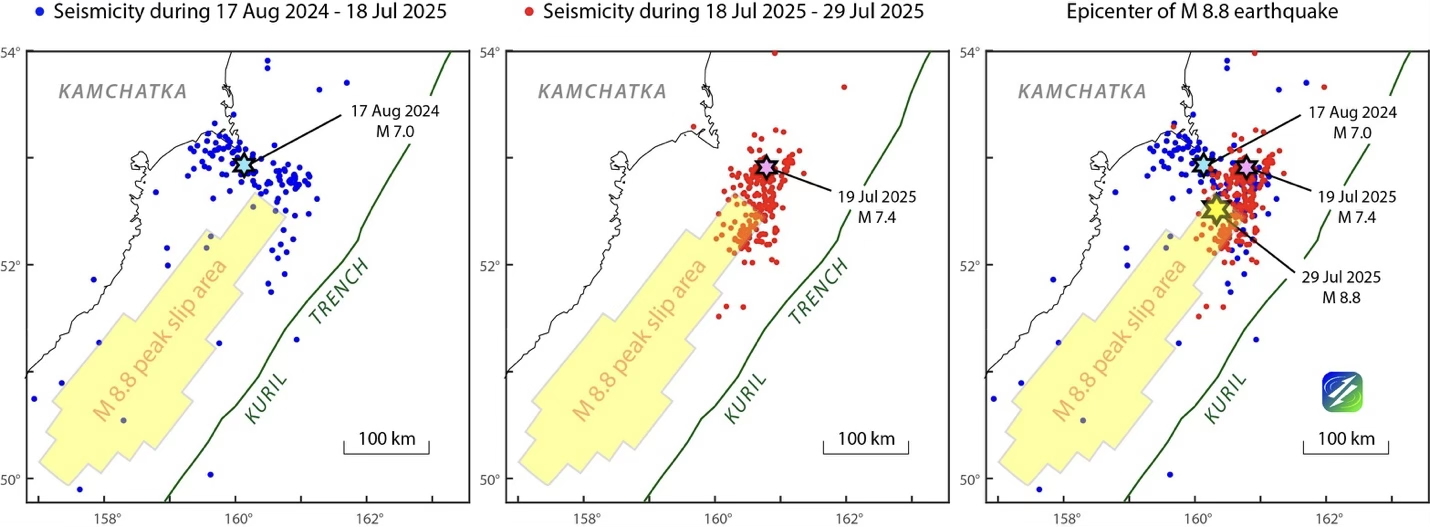
Figure 1. Each shock struck in an aftershock cluster of the preceding event, suggesting that these are not random events. Instead, one likely promoted the next in some kind of chain reaction. Notice as well that the magnitude 7.0 event produced about the same number of aftershocks in a year that the magnitude 7.4 did in 10 days. We use the ANSS catalog. In yellow is the greater than 4 meter slip area in the USGS model. Credit: Temblor, CC BY-NC-ND 4.0

Alka Tripathy-Lang is a freelance science writer based in Chandler, Arizona, and holds a Ph.D. in geoscience.
Latest posts by Alka Tripathy-Lang, Ph.D. (see all)
- Living through the Loma Prieta earthquake - October 21, 2021
- The Great Quake Debate: an interview with seismologist and author Susan Hough - August 27, 2020
- Salton Sea Swarm quiets down - August 12, 2020