
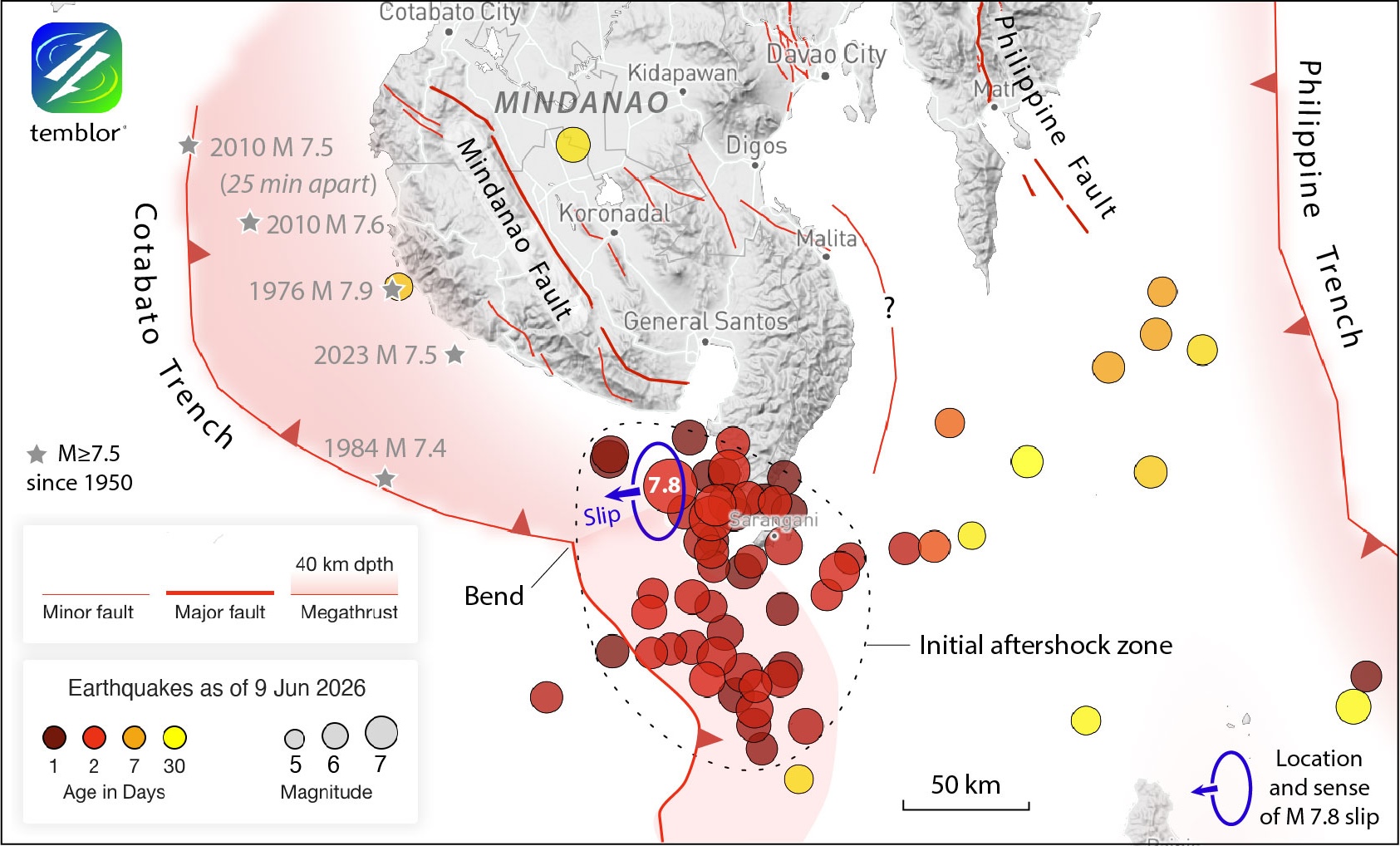
Figure 1. The initial aftershocks cover a 165 by 150 kilometer area south of General Santos City, on a rupture associated with the Cotabato Trench where it subducts beneath the southern island of Mindanao. A possible left-lateral strike-slip fault, the Mindanao Fault, lays to the north of the rupture. Another left-lateral strike-slip fault, the Philippine Fault, resides northeast of the rupture. The trace of the Cotabato Trench is from Llamas et al. (2026) and DOST-PHIVOLCS. The 100 kilometer-long section of the trench between the 2026 magnitude 7.8 quake and the 2023 magnitude 7.5 event could rupture next. Earthquake locations and magnitudes are from the USGS. Credit: Stein and Toda, 2026 CC BY-NC-ND 4.0

Figure 1. The initial aftershocks cover a 165 by 150 kilometer area south of General Santos City, on a rupture associated with the Cotabato Trench where it subducts beneath the southern island of Mindanao. A possible left-lateral strike-slip fault, the Mindanao Fault, lays to the north of the rupture. Another left-lateral strike-slip fault, the Philippine Fault, resides northeast of the rupture. The trace of the Cotabato Trench is from Llamas et al. (2026) and DOST-PHIVOLCS. The 100 kilometer-long section of the trench between the 2026 magnitude 7.8 quake and the 2023 magnitude 7.5 event could rupture next. Earthquake locations and magnitudes are from the USGS. Credit: Stein and Toda, 2026 CC BY-NC-ND 4.0

Figure 1. The initial aftershocks cover a 165 by 150 kilometer area south of General Santos City, on a rupture associated with the Cotabato Trench where it subducts beneath the southern island of Mindanao. A possible left-lateral strike-slip fault, the Mindanao Fault, lays to the north of the rupture. Another left-lateral strike-slip fault, the Philippine Fault, resides northeast of the rupture. The trace of the Cotabato Trench is from Llamas et al. (2026) and DOST-PHIVOLCS. The 100 kilometer-long section of the trench between the 2026 magnitude 7.8 quake and the 2023 magnitude 7.5 event could rupture next. Earthquake locations and magnitudes are from the USGS. Credit: Stein and Toda, 2026 CC BY-NC-ND 4.0

Follow her
Latest posts by Alka Tripathy-Lang, Ph.D. (see all)