
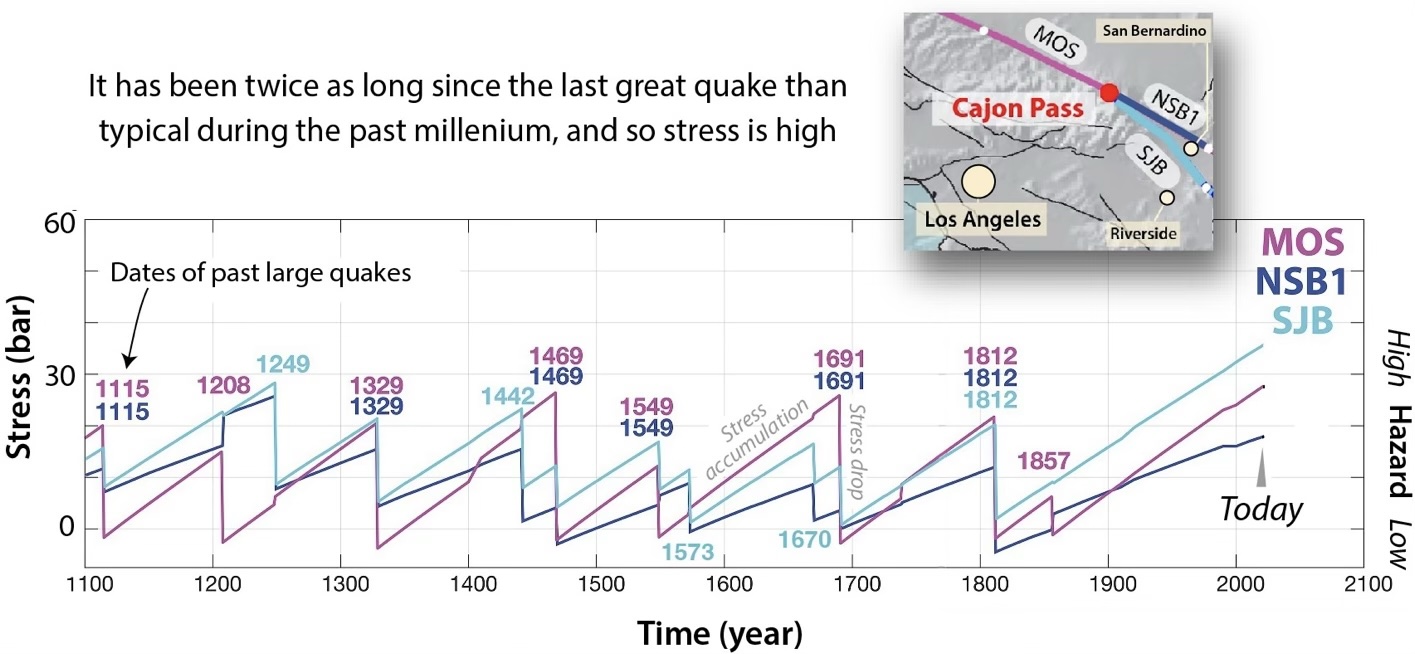
Figure 4. This figure shows the calculated stress histories on the three fault sections that converge at Cajon Pass. Mojave South (MOS) and North San Bernardino (NSB1) are on the San Andreas Fault, and San Jacinto Bernardino (SJB) is on the San Jacinto Fault. Stress steadily builds at a rate determined by the fault slip rate and locking depth (“stress accumulation”), and then is modeled to fully recover when the earthquake strikes (“stress drop”). Credit: Modified from figure 8a of Burkhard et al. (2026)

Alka Tripathy-Lang is a freelance science writer based in Chandler, Arizona, and holds a Ph.D. in geoscience.
Latest posts by Alka Tripathy-Lang, Ph.D. (see all)
- Living through the Loma Prieta earthquake - October 21, 2021
- The Great Quake Debate: an interview with seismologist and author Susan Hough - August 27, 2020
- Salton Sea Swarm quiets down - August 12, 2020