
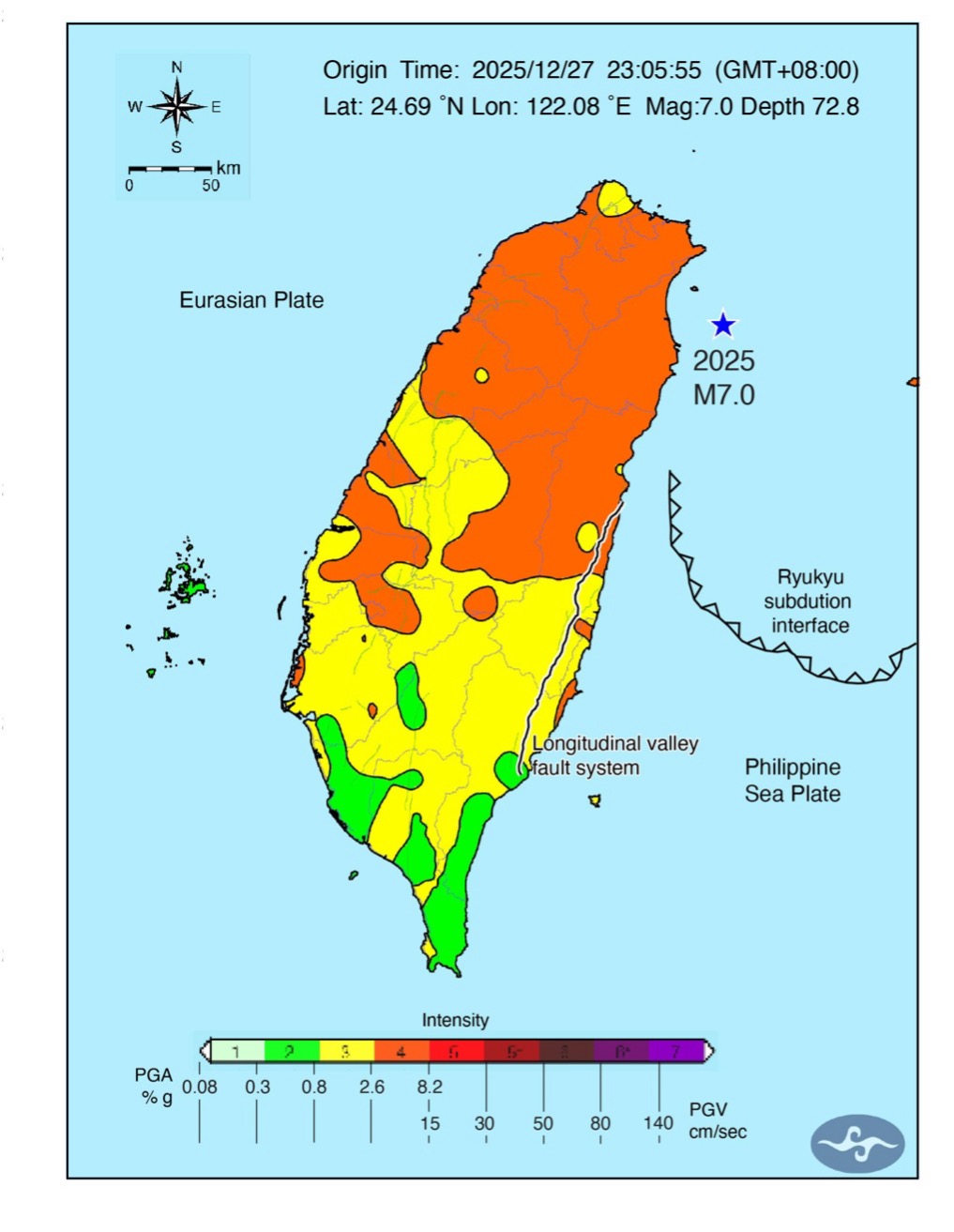
Figure 1. Peak ground shaking from the December 27, 2025, magnitude 7.0 earthquake off eastern Taiwan. Colors show the distribution of peak ground acceleration (PGA) across the island, with warmer colors indicating stronger shaking. Although the earthquake ruptured deep within the subducting Philippine Sea Plate — about 70 kilometers below the surface—it produced widespread shaking across Taiwan. This pattern reflects the efficient transmission of seismic waves through the cold, dense slab, allowing deep earthquakes to be felt far from their source. The Ryukyu subduction interface and the Longitudinal Valley Fault, which together form the plate boundaries between the Eurasian Plate and the Philippine Sea Plate, define the regional tectonic setting. The star marks the offshore epicenter. Credit: Modified from the Central Weather Administration, Taiwan
Latest posts by Rachel Crowell (see all)

