
A new paper suggests that at Cajon Pass, the stress is higher than at any time in the past thousand years. Is this finding obvious or alarming?
By Ross Stein, Temblor, Inc.
Citation: Stein, R.S., 2026, Is Southern California’s Cajon Pass an ‘earthquake gate’ ready to open?, Temblor, http://doi.org/10.32858/temblor.378
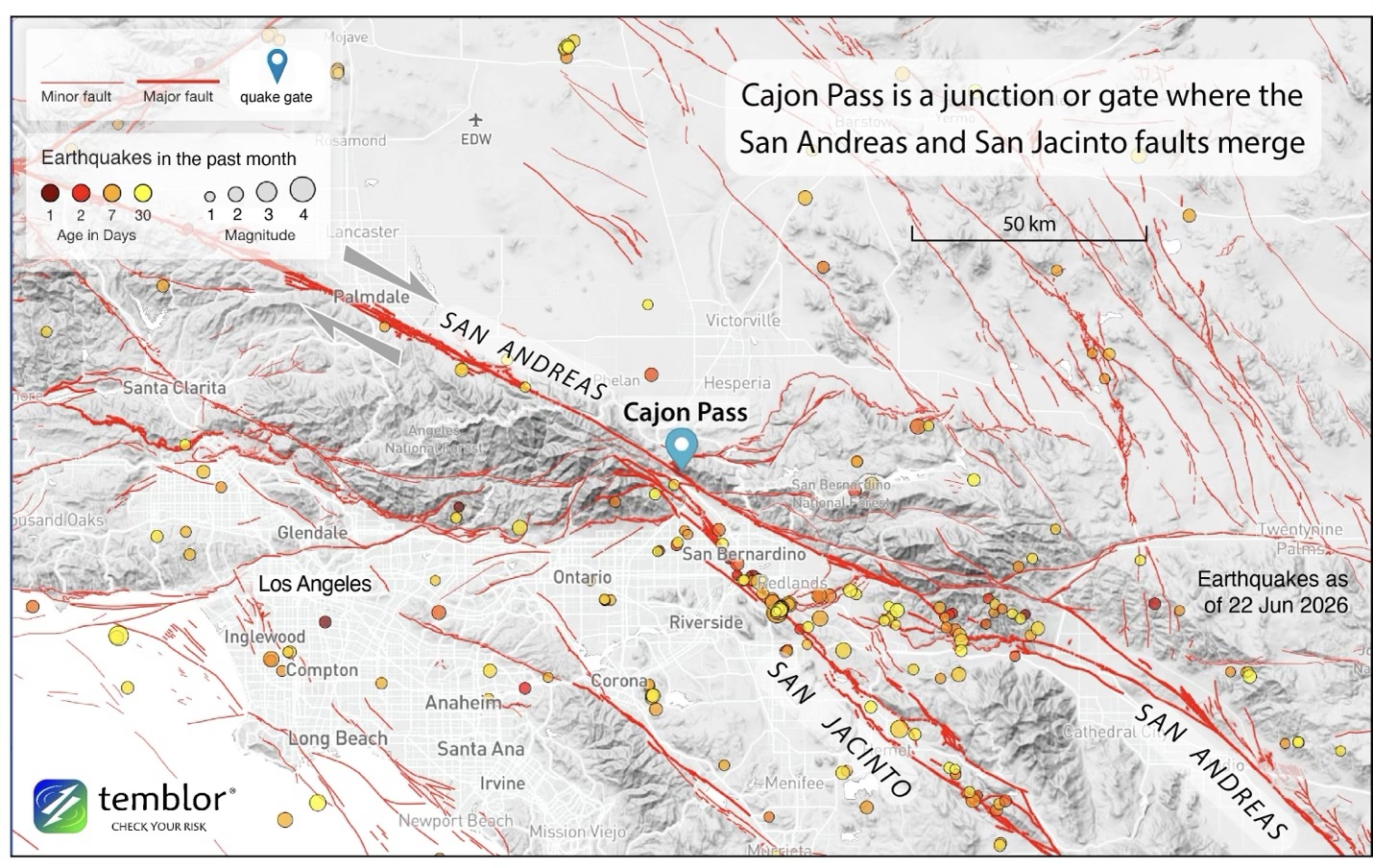
Southern California’s largest faults have been unusually quiet over the last century. More than 165 years have passed since the great 1857 Fort Tejon earthquake ruptured the southern San Andreas Fault. During that time of relative seismic quiescence, tectonic forces have continued to load both the San Andreas and neighboring San Jacinto faults in the Cajon Pass area (Figure 1).
A new study in the Journal of Geophysical Research suggests that this long period of stress accumulation has pushed the junction of these faults, located near Cajon Pass, to one of its highest stress levels in at least the past 1,000 years, raising the possibility that the region could more readily transmit a large rupture between the two fault systems.
The study, led by Liliane Burkhard of the University of Bern and the University of Hawai’i, tackles an important question: Why do some large earthquakes rupture through Cajon Pass while others stop there? Rather than simply noting that Southern California’s faults have gone longer without a major earthquake than their northern counterparts, the authors reconstruct how stress has accumulated and been redistributed across the southern San Andreas and San Jacinto fault systems over the past millennium.
Their model suggests that the Cajon Pass junction currently occupies an unusually stressed state that could favor multifault ruptures. The team’s approach is physically plausible, but their conclusions rest on two key assumptions: that the prehistoric earthquake record correctly captures the timing and extent of past ruptures, and that each earthquake resets all of the accumulated stress before the loading cycle begins again.
Burkhard and colleagues say that the results improve our understanding of earthquake interactions in Southern California and help refine regional hazard assessments, but do they?
San Andreas Fault: NorCal vs. SoCal
Along the San Andreas fault zone, there’s good reason to think the stress is higher in Southern California than Northern California based on elapsed times (Figure 2). It’s been 120 years since the 1906 San Francisco magnitude 7.8 shock struck, and 158 years since the approximate magnitude 6.7 Hayward earthquake occurred. Contrast that with Southern California, where it’s been 169 years since the Fort Tejon quake, with a magnitude of about 7.8, struck, and 214 years since the 1812 Wrightwood event, with a magnitude of about 7.5, occurred. The elapsed times tend to be longer still, father to the southeast of Cajon Pass (Figure 2).
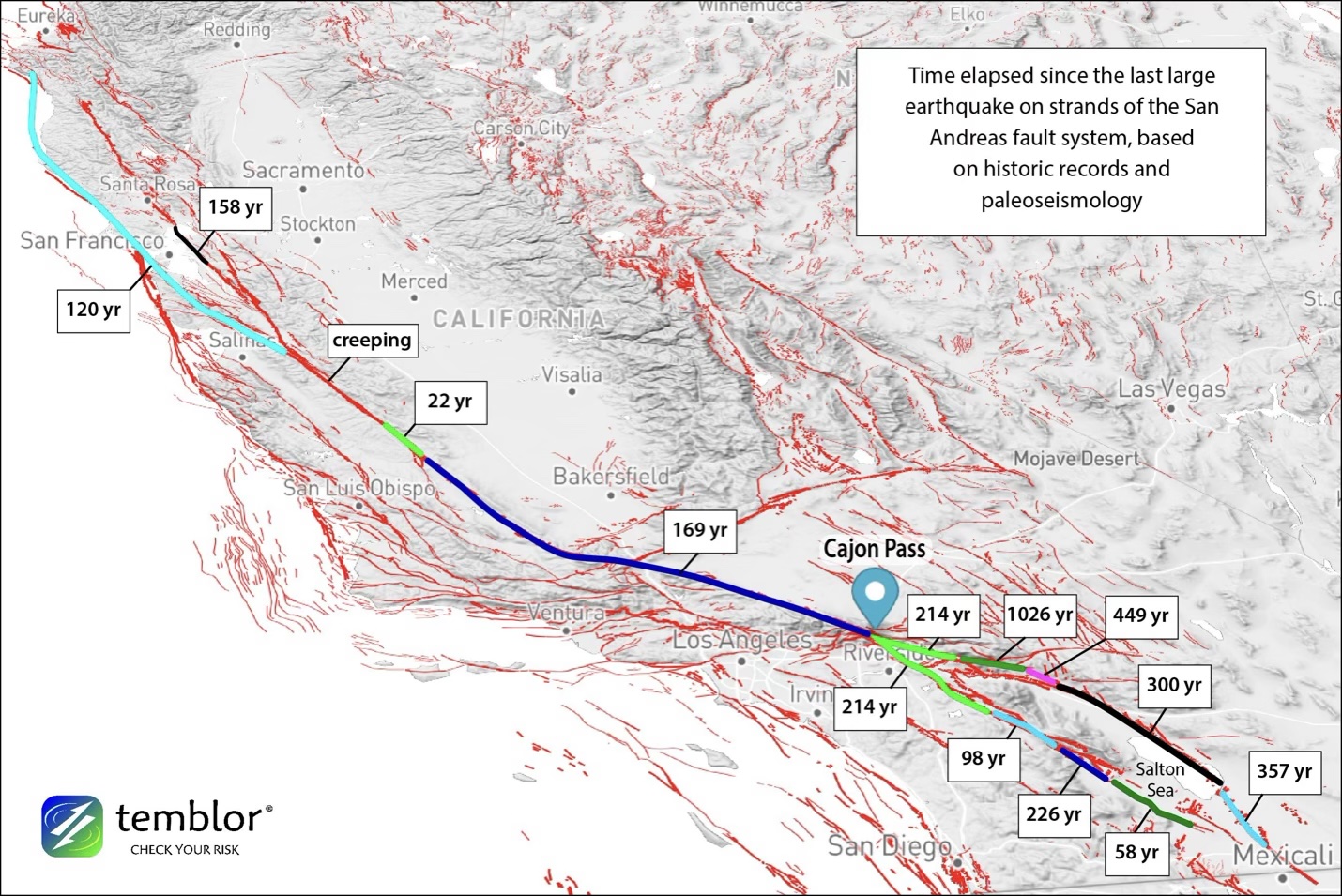
So, if fault slip rates and earthquake magnitudes were uniform along the San Andreas system (they aren’t, but it’s a thought experiment), one would expect the next great quake to strike Southern California. One might even hypothesize the quake nucleating near the Salton Sea and propagating to the northwest, where it could rupture through Cajon Pass and extend to central California, pouring seismic energy into the Los Angeles basin. So, how does this study deepen our understanding of the stress buildup beyond this simple view?
Burkhard et al. don’t simply compare elapsed times since the last earthquakes. Instead, they attempt to reconstruct the evolving stress on individual fault sections by combining paleoseismic histories, geologic slip rates, locking depths, and Coulomb stress transfer between neighboring faults. They do this because stress, not time, is the crucial component to earthquake promotion. This approach allows them to ask not merely which faults have been quiet the longest, but how previous earthquakes may have redistributed stress through the fault network over the past millennium.
Cajon Pass
The authors describe Cajon Pass (Figure 1) as an “earthquake gate,” in which some quakes rupture through the pass (open gate events) and some are stopped by it (closed gate events). Cajon Pass is important geologically as a fault junction, and societally because water and power conduits run through the pass to supply greater Los Angeles.
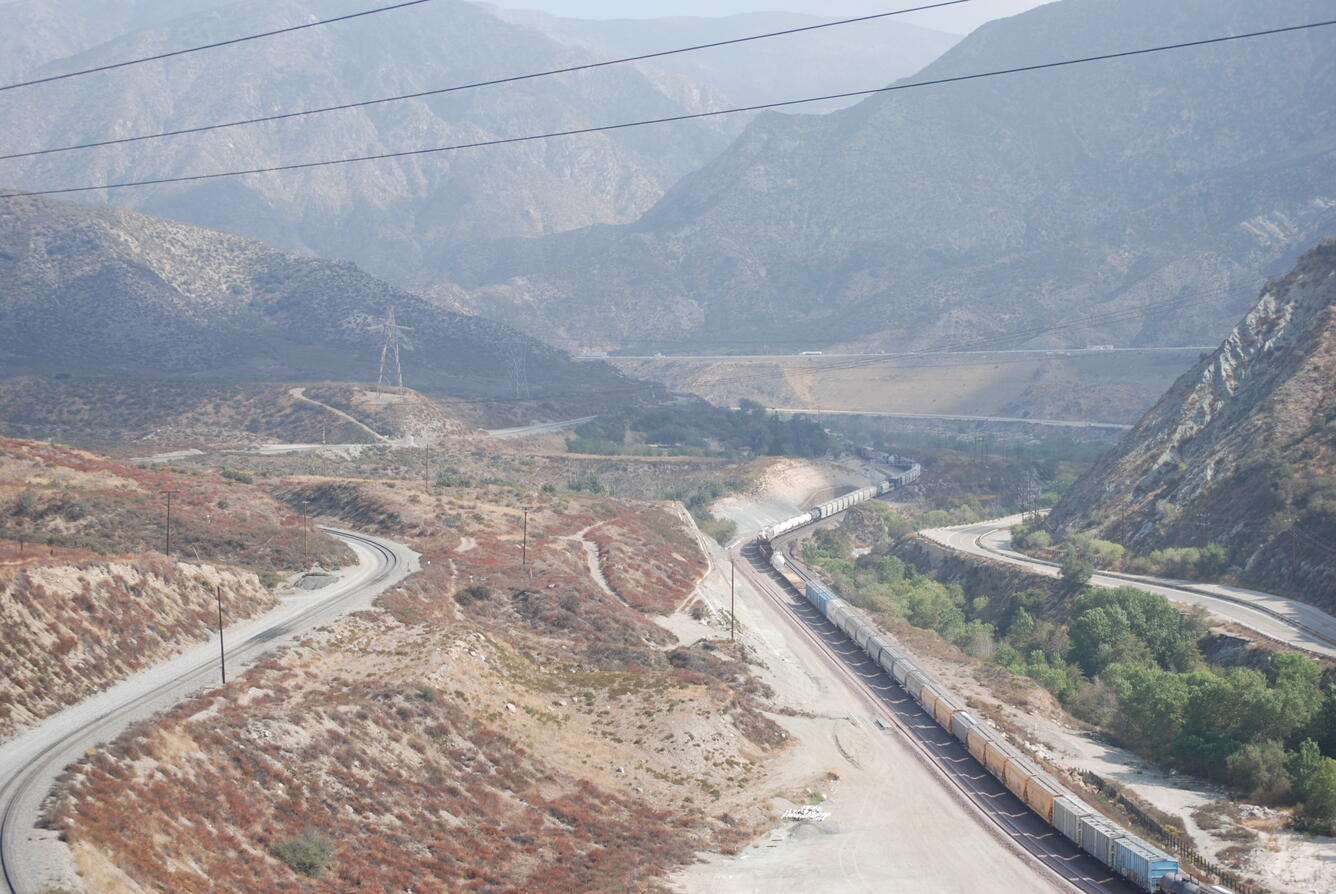
It’s striking how splintered these major faults are at the surface, and the best evidence suggests they are just as intricate at depth. One enduring puzzle is that the San Andreas Fault northwest of Cajon Pass slips at roughly twice the rate of the San Jacinto Fault to the southeast, yet the San Jacinto produces about 10 times more small earthquakes. No one fully understands why.
Cajon Pass is also just one of many fault junctions in Southern California. Southeast of the pass, the San Andreas splits into two strands before rejoining farther south. These geometric complexities — and many smaller splays and branch faults — are necessarily simplified in the Burkhard et al. model.
Two key assumptions
The paper is comprehensive and very well reasoned. But those two key assumptions govern the outcome. First is the paleoseismic record. Burkhard et al. base their model on a particular interpretation of the paleoseismic record, including earthquake dates and rupture extents inferred from trench data, together with U.S. Geological Survey fault slip rates and locking depths. The team assumes that the dates of prehistoric earthquakes are essentially correct — a fairly robust assumption — but also that the rupture extents and magnitudes inferred from those dates are correct, which is considerably more uncertain. Figure 3 shows the authors’ reconstruction of the past 1,000 years of earthquakes based on that interpretation of the paleoseismic record.
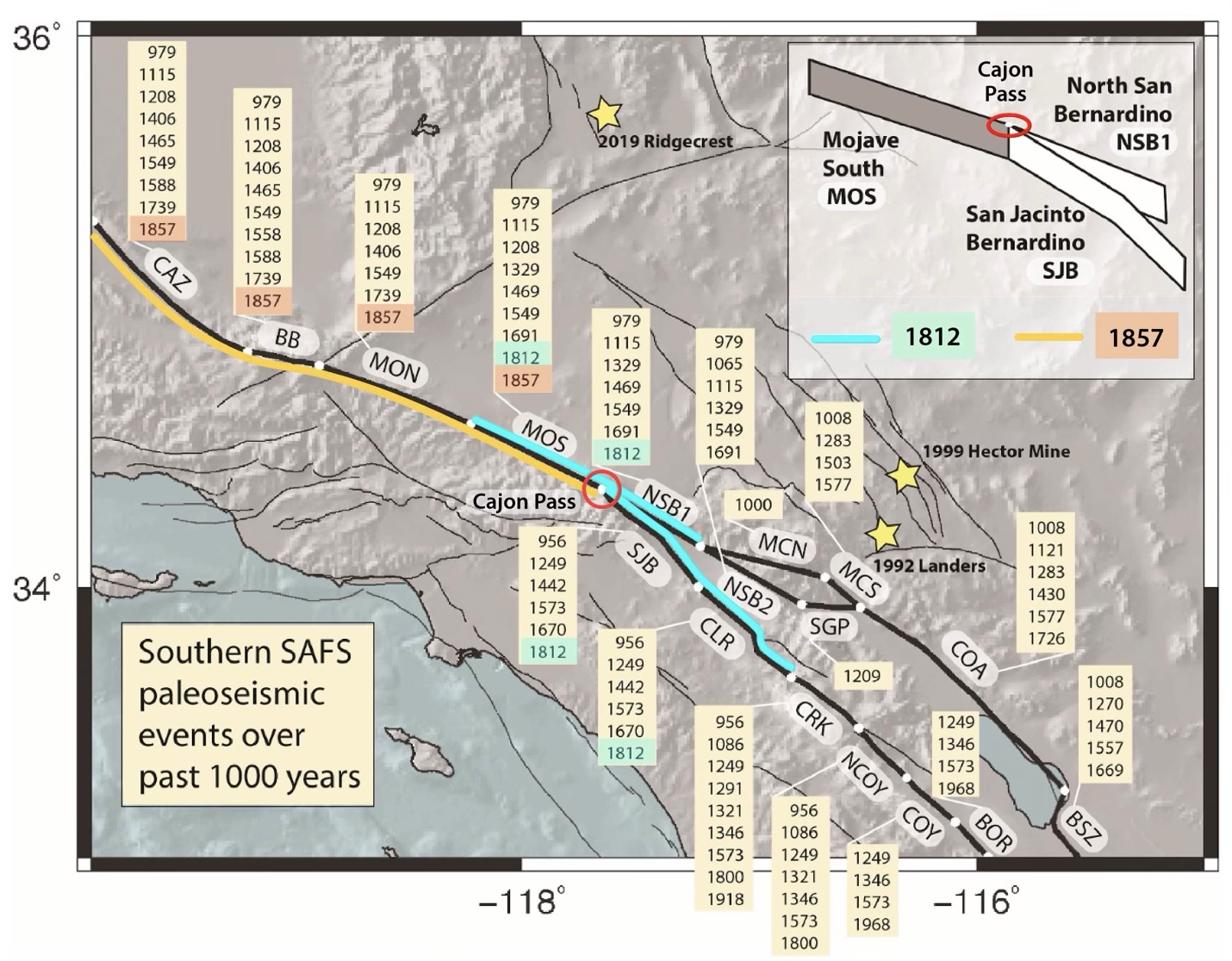
Paleoseismic magnitudes are inherently uncertain because trench studies constrain the timing of past earthquakes much better than their size. Estimating magnitude requires correlating earthquake horizons from isolated trench excavations along the fault, a process sometimes called stringing pearls, to infer the total rupture length, rather than relying on the slip at one point. So, the size and extent of the prehistoric quakes could be exaggerated, and there is evidence that paleoseismology might inadvertently overestimate earthquake recurrence rates (Jackson, 2014; Jackson, 2019; Biasi and Scharer, 2019).
The second key assumption is that each earthquake fully releases all the accumulated stress on the ruptured fault segment, after which stress starts building up again. This is known as the slip-predictable earthquake model, after Shimazaki and Nakata (1980). There is now abundant evidence that neither the slip-predictable nor its alternative, the time-predictable model, is satisfied by earthquake slip and recurrence data, perhaps in part because earthquakes interact; few faults are isolated. Nevertheless, the authors are entitled to make reasonable simplifying assumptions like this one as long as they point out the consequences of those choices, which they do.
Principal finding
My view of the key finding of Burkhard et al. (2026) is summarized in Figure 4.
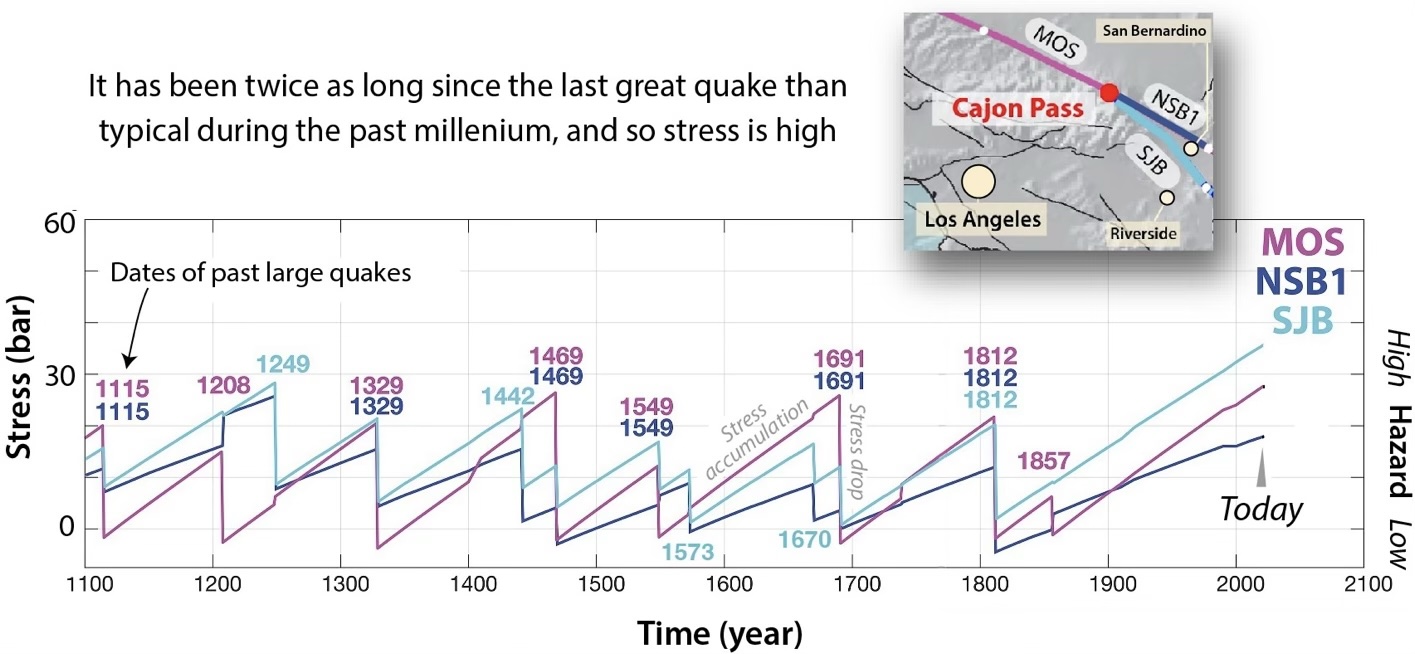
The most striking result is that the three fault sections converging at Cajon Pass have all accumulated high Coulomb stress. In the authors’ interpretation, this convergence of high stress makes Cajon Pass more likely to transmit a rupture from one fault system to the other. In other words, the “earthquake gate” may be open.
At the same time, the modeled stress history also illustrates why earthquake forecasting remains so difficult. Between 1329 and 1469, the interval between major ruptures reached about 140 years without triggering a large earthquake. Notice that the inter-event times don’t follow any regular pattern: Faults do not fail on a schedule. We cannot talk about faults bing ten months pregnant, as their gestation periods are highly variable.
Bottom line
Burkhard et al. reinforce decades of evidence that the southern San Andreas system is heavily loaded while offering a physically based explanation for why Cajon Pass may sometimes allow multifault ruptures and sometimes stop them. But today’s elevated stress could persist for decades before the next great rupture occurs — or it could soon be released. Perhaps the strongest conclusion is that Burkhard et al. have strengthened the view that if the San Andreas or San Jacinto faults were to separately or jointly rupture tomorrow, no one should be surprised.
Yet, the study offers nothing predictive of that occurrence, nor am I aware of any other data pointing toward an imminent rupture. As an example, look again at Figure 1. There’s no concentration of quakes in the past month at or near Cajon Pass, and for reasons clear to no one, the San Jacinto Fault has many more quakes than the adjacent San Andreas Fault, despite having similar slip rates along those parallel sections.
The paper narrows some important uncertainties when it comes to regional hazard assessments, and so their results are not obvious and they are important. But, the study does not eliminate the largest uncertainty: when and how the next major Southern California earthquake will begin and propagate. There is no reason for alarm, but there is an acute need to be prepared.
Reviewed by Liliane Burkhard, Ph.D.
References
Burkhard, L. M. L., Smith-Konter, B. R., Scharer, K. M., & Sandwell, D. T., 2026, Cajon Pass and the southern San Andreas Fault system: Earthquake cycle stress accumulation and present-day loading, Journal of Geophysical Research: Solid Earth, 131, e2025JB033213, http://doi.org/10.1029/2025JB033213
Jackson, D. D., 2014, Did someone forget to pay the earthquake bill?, Seismological Research Letters, 85, 421.
Jackson, D. D., 2019, Mind the Gap, Presentation at SCEC Annual Meeting, Palm Springs.
Lozos, J. C., 2016, A case for historic joint rupture of the San Andreas and San Jacinto faults, Science Advances, 2(3), e1500621, http://doi.org/10.1126/sciadv.1500621
Rodríguez Padilla, A. M., Oskin, M. E., Rockwell, T. K., Delusina, I., & Singleton, D. M., 2021, Joint earthquake ruptures of the San Andreas and San Jacinto faults, California, USA, Geology, 50(4), 387–391, http://doi.org/10.1130/G49415.1
Biasi, G. P., & Scharer, K. M., 2019, The current unlikely earthquake hiatus at California’s transform boundary paleoseismic sites, Seismological Research Letters, 90(3), 1168–1176, http://doi.org/10.1785/0220180244
Scharer, K. M., & Yule, D., 2020, A maximum rupture model for the southern San Andreas and San Jacinto faults, California, derived from paleoseismic earthquake ages: Observations and limitations, Geophysical Research Letters, 47(15), e2020GL088532, http://doi.org/10.1029/2020GL088532
Shimazaki, K., & Nakata, T., 1980, Time-predictable recurrence model for large earthquakes, Geophysical Research Letters, 7(4), 279–282, http://doi.org/10.1029/GL007i004p00279
Yule, J. D., Sieh, K., & Howland, C., 2007, Evidence for large earthquakes on the San Andreas Fault at the Burro Flats paleoseismic site: A.D. 150 to present, Poster presented at SCEC Annual Meeting, Palm Springs.
Copyright
Text © 2026 Temblor. CC BY-NC-ND 4.0
We publish our work — articles and maps made by Temblor — under a Creative Commons Attribution-NonCommercial-NoDerivatives 4.0 International (CC BY-NC-ND 4.0) license.
For more information, please see our Republishing Guidelines or reach out to news@temblor.net with any questions.

- Is a doublet signaling the formation of a new basin in Sındırgı, Western Türkiye? - August 11, 2026
- Venezuela’s doublet leaned toward Caracas - June 30, 2026
- Is Southern California’s Cajon Pass an ‘earthquake gate’ ready to open? - June 29, 2026