
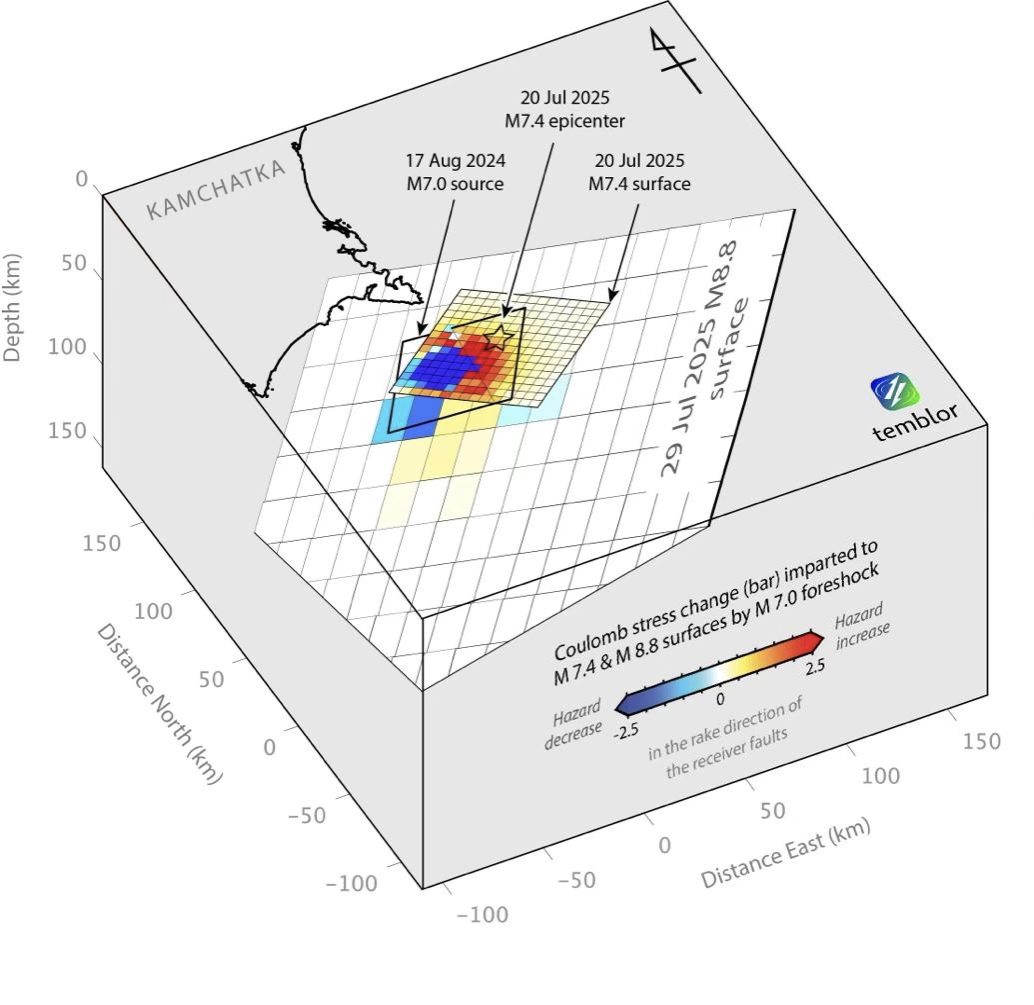
Figure 2. The perimeter of the ‘source’ earthquake that imparted the stress is outlined in black. The sources in this model are the 2024 magnitude 7.0 event (rectangle bordered in bold), and the receivers of stress are the 2025 rupture surface (the fine mesh rectangle), and the megathrust surface (coarse mesh rectangle). Stress imparted by the 2024 foreshock brought the epicentral patch of the 2025 magnitude 7.4 foreshock about 1.5 bar closer to failure, and the megathrust surface up to 0.5 bars closer to failure, although there are adjacent patches of stress decrease (blue). Credit: Temblor, CC BY-NC-ND 4.0

Alka Tripathy-Lang is a freelance science writer based in Chandler, Arizona, and holds a Ph.D. in geoscience.
Latest posts by Alka Tripathy-Lang, Ph.D. (see all)
- Living through the Loma Prieta earthquake - October 21, 2021
- The Great Quake Debate: an interview with seismologist and author Susan Hough - August 27, 2020
- Salton Sea Swarm quiets down - August 12, 2020